Book a Flight to Heraklion
expand_more
1 Passenger, Economy
expand_morePromotional Code
expand_moreexpand_more
today
today
To book tickets for children traveling alone click here
Find the lowest fares to Heraklion
flight_takeoff
flight_land
€
There are no fares that match your filter criteria. Please adjust your filters.
There are no fares that match your filter criteria. Please adjust your filters.*Fares displayed have been collected within the last 48hrs and may no longer be available at time of booking. Additional fees and charges for optional products and services may apply.
AEGEAN popular flights to Heraklion
flight_takeoff
flight_land
€
Cabin Class option undefined Selectedkeyboard_arrow_down
Select Travel Class
There are no fares that match your filter criteria. Please adjust your filters.
There are no fares that match your filter criteria. Please adjust your filters.*Fares displayed have been collected within the last 48hrs and may no longer be available at time of booking. Additional fees and charges for optional products and services may apply.

Plan your Trip to Heraklion
The capital town of the most densely populated prefecture in Crete, Heraklion is the gateway passed through by most visitors to the island. It is one of the most historic cities in the Mediterranean, with an urban character buzzing with life in both summer and winter! It was here that the Minoan civilization enjoyed its heyday, and where you can discover the unique masterpieces of the Minoan era in the city’s archaeological museum, one of the most important in Europe, or at Knossos, Phaestus and Archanes.
The more recent past can still be seen in all its glory in the Venetian walls of the city, the old Ottoman buildings, the Loggia, the Basilica of Saint Mark, the Morosini Fountain on Lions Square, and the Koules Fort. No contemporary account of Heraklion would be complete without a reference to the exceptional Cretan cuisine, the lively evening entertainment available in Hersonisos and Malia, and the wide choice of hotels and resorts, with something available to suit every taste.
Book an Aegean Airlines flight to Heraklion and explore a city which has inspired artists like Nikos Kazantzakis and El Greco!
Heraklion
Heraklion is the largest town in Crete and is famous for its historic heritage. Visit the full of traditional tastes town market and enjoy its endless and pulsating night life.

The Venetian Walls: The massive walls encircling the city made mediaeval Iraklion the best defended city in the Mediterranean. You should pause for a while on the Martinego Bastion, on the southern side, the final resting place of the great writer Nikos Kazantzakis.
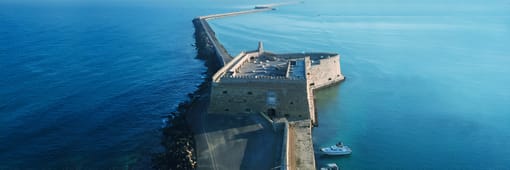
Koules: The Roman prison fortress looms over the entrance to the harbour and offers panoramic views of the city. It was here that the Turks incarcerated the Cretans who rose up against their rule; today it is a venue for cultural events. Walk along to Saint Mark’s, taking the eastern side of the walls, and admire the marble reliefs of the winged lions, as well as the navy yards, the vaulted buildings along the waterfront, where the Venetians constructed their ships.
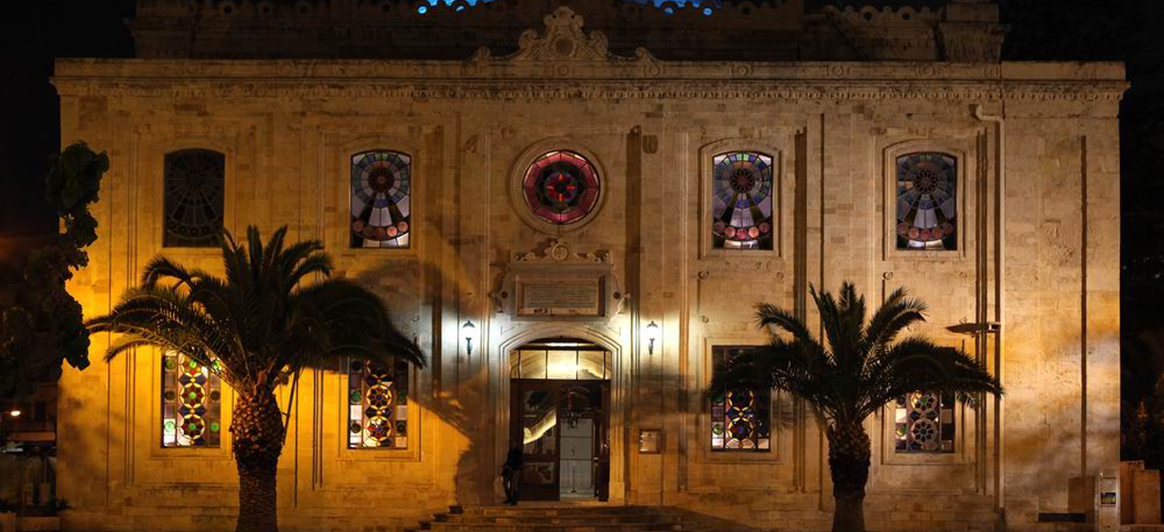
Saint Titus – Fountain of the Lions: Make your way up 25 Avgoustou Street, the main street of the city and you will come to the heart of Iraklion, the location of Agiou Titou Square with its long-suffering church – formerly a mosque – and Eleftheriou Venizelou Square, also known as Lions Square from the four marble lions adorning the exquisite Morosini Fountain. The latter, close to the Church of Saint Mark, was built by the Venetian Governor General of the island, Francisco Morosini, for purely functional reasons, but is now one of the city’s main landmarks, and one of its busiest locations.
The Loggia: This former noblemen’s club, under the Venetian occupation, now the Municipal Hall, located at the end of 25 Avgoustou St., is perhaps the most elegant example of Venetian architecture in the whole city. Adorned with rich decorative features, and now fully renovated, it was rightly declared in 1987 the best restored historic building in Europe.
Iraklion Archaeological Museum: This is one of the largest museums in Greece, and one of the most important in Europe. Its collections are housed in a gem of a building, dating from 1937, an excellent example of Greek modernism, on the site formerly occupied, until 1856, by the Catholic Monastery of Saint Francis. It is home to the world’s finest collection of Minoan antiquities, including the snake goddess, important frescoes from the Minoan palaces, the famous Disc of Phaestus, and also representative examples of all phases of Cretan history and prehistory, covering a period of about 5,500 years.
Address: Xanthoudidou and Hatzidaki Streets, tel.: +30 2810 279086
History Museum: The History Museum is housed in a two-storey, listed, neoclassical building dating from the turn of the century, which is one of the city’s true architectural gems. The creation of the Society for Cretan Historical Studies, the museum contains exhibits which illustrate the entire history of Crete, from the early Christian era to the present day. Soak up the atmosphere of the Crete of old as you admire the frescoes, icons, coins, jewellery, relics of the Cretan Uprising, traditional costumes, embroidery and musical instruments.
Address: 27 S. Venizelou Street and 7 Kalokairinou Street, tel.: +30 2810 283219, www.historical-museum.gr
Knossos: Just 5km from Iraklion lies the most important monument to Minoan civilization, the labyrinthine palace (20,000m2) of Minos, King of Crete, uncovered in excavations by the British archaeologist Sir Arthur Evans. Marvel at the lavish opulence of the rooms, the colourful frescoes, the pioneering drainage system and the unique architectural layout.
Archaeological site: tel.: +30 2810 231940, +30 2810 226470, +30 2810 226092
Phaestus: More accurately known as the Minoan Palace of Phaestus. This highly important archaeological site, dating from 2000 BC, is 55km south of Iraklion and features royal apartments, storage areas, cisterns etc. The site as a whole also includes the Royal Villa of Aghia Triada, the summer palace of the former King of Greece, on a hill close to the banks of the Yeropotamos River.
Archaeological site: Tel.: +30 28920 42315
Ancient Gortyn: Another exceptional archaeological site, this one 40 minutes south of Iraklion. Ancient Gortyn was one of the most important cities of Minoan Crete. Its impressive remains extend over an area of about a thousand acres and include imposing public buildings, still standing, such as the amphitheatre, the Roman Odeon, the Praetoreum, the water cisterns and public baths. Of particular interest are the remains of the Basilica of Saint Titus.
Archaeological site: Tel.: +30 28920 31144
Archanes: Just a fifteen minute drive from the centre of Iraklion, Archanes is a contemporary example of fine management of the Greek cultural heritage. The picturesque market town of Archanes, at the foot of Mt. Yiouhtas, stands on the site of ancient Minoan settlements dating back as far as 6000 BC. Today, with funding from restoration and protection programmes, the site has been transformed into a model village described, not unjustly, in the tour guides as one of the most remarkable villages, architecturally speaking, in the whole of Crete.
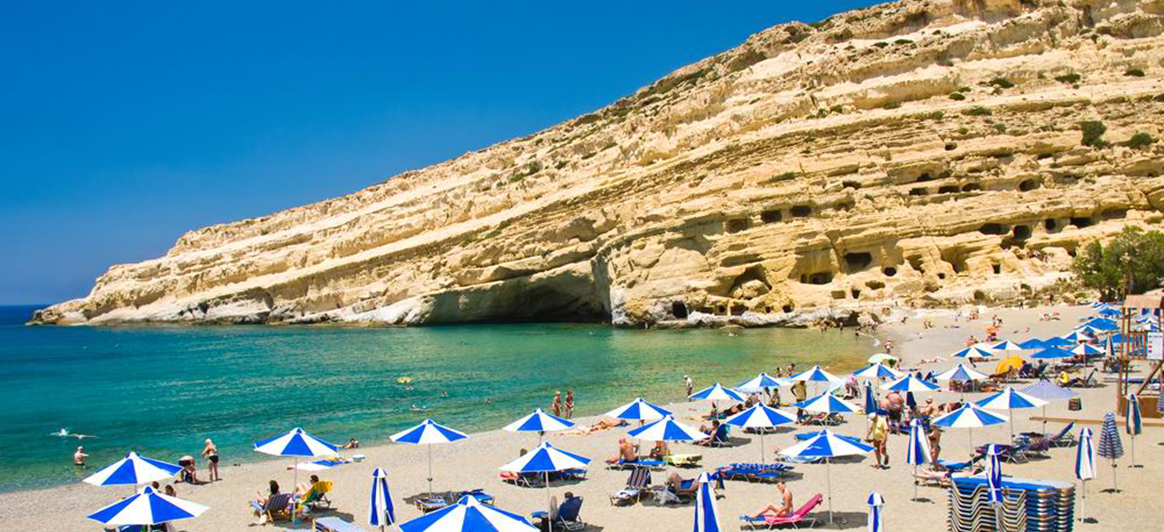
Beaches: As is the case across the island, the beaches of the northern section are superior in terms of organization and amenities, in contrast to the southern section where the more deserted, less developed beaches are found. A short distance from Iraklion you will find the organized beaches of Ammoudara, Agia Pelagia, Lygaria, as well as the peaceful Bay of Madé. The best beaches on the eastern side are the long expanse of beach at Akti, Hani Kokkini, Malia and Palaiokastro. In the southern section the scenery changes dramatically. You should explore Kommos, with its rock formations and the deep shade of the trees, as well as famous Matala, a place of pilgrimage for the hippies of the 1960s, with its impressive natural caves and blue waters.

Just like any city, Iraklion offers lots of shopping opportunities. There are many famous local products, and the local market is considered the best in Crete. The Municipal Market on 1866 Street (1866 was the year of the Cretan uprising against the Turks) extends from the Meidani to Kornarou Square and is a sight worth seeing in its own right. Among the busy stalls you will find little treasures like the Venetian arch at the Koudoumas Coffee House, or the 16th century church, surrounded by modern buildings, which can only be accessed through the Toulis Bakery. Shop for olive oil, raisins, any kind of Cretan cheese (graviera, anthotyro), tsikoudia (a strong spirit, similar to ouzo), aromatic herbs, wild greens and bananas! As you approach the end of the market, on Karterou St., you will come to the busy Fish Market, with stalls laden with fresh fish.

In restaurants, traditional tavernas and local kafeneia, all other options bow down before the superiority of Cretan cuisine, which somehow manages to transform the simplest natural ingredients into food fit for the gods. You should try the Cretan dako (barley rusks soaked in oil served with tomato and feta cheese), the liopsomo (olive bread), hare, various kinds of pies (meat pie, cheese pie, pie with yoghurt, leek pie and fennel pie), fresh fish in various forms, snails fried in oil, vinegar and salt, roasted goat, kaltsounia (pies with a filling of anthotyro cheese and spearmint) and of course the famous gamopilafo (boiled rice with various meats), which formerly was served only at weddings, but now features on most island restaurant menus. As a modern university town, Iraklion offers every kind of nightlife, both in the centre (in the so-called ‘fun triangle’ – the pedestrians-only Daidalou, Korai and Perdikari Streets), close to the port (Bofor and Theotokopoulou Streets) and the Hersonisos district, internationally renowned for its exciting nightlife. For something a little less frenzied, try the area behind Lion Square, Theotokopoulou Park (where there are places serving good ouzo and raki) and Eleftherias Square, where the patisseries and traditional kafeneia are full of local people enjoying a coffee and the newspaper on Sunday mornings.

- Events: There are cultural events all year round in Iraklion, usually staged at the Koules Fort, the Kazantzakis Garden Theatre or the Pananeio Hospital. Of particular note is the Summer Festival, which starts in June and goes on till September, featuring plays, talks and lectures, concerts and musical-theatrical events of all kinds, culminating in evenings of traditional Cretan music.
- Anniversaries and Feast Days: The anniversary of the Battle of Crete (20-28 May) is celebrated with great solemnity. Another important anniversary is the Feast of Saint Titus, one of the city’s patron saints, and, on 11 November, the Feast of Saint Minas. In both cases the celebrations culminate in festivities and a traditional Cretan feast. Outside the city walls one of the most important festivals is the grape festival at Archanes (10-15 August), which features an exhibition of famous wines, and the Klidona Festival (24 June), also at Archanes, which features a revival of the old custom of fire-dancing.

Transport from the airport
Aegean Airlines flights land at the international Nikos Kazantzakis Airport, Iraklion. The airport has duty free shops, restaurants and cafes, a bureau de change, a bank and car rental offices. It is situated just 5km to the east of the city. Taxis are the best way to get to and from the airport, given that the fares are very reasonable and the distance to Iraklion not great. If you prefer to take a bus, there are a number of local services linking the airport to a number of points around the city.

The Venetian Walls: The massive walls encircling the city made mediaeval Iraklion the best defended city in the Mediterranean. You should pause for a while on the Martinego Bastion, on the southern side, the final resting place of the great writer Nikos Kazantzakis.
Koules: The Roman prison fortress looms over the entrance to the harbour and offers panoramic views of the city. It was here that the Turks incarcerated the Cretans who rose up against their rule; today it is a venue for cultural events. Walk along to Saint Mark’s, taking the eastern side of the walls, and admire the marble reliefs of the winged lions, as well as the navy yards, the vaulted buildings along the waterfront, where the Venetians constructed their ships.
Saint Titus – Fountain of the Lions: Make your way up 25 Avgoustou Street, the main street of the city and you will come to the heart of Iraklion, the location of Agiou Titou Square with its long-suffering church – formerly a mosque – and Eleftheriou Venizelou Square, also known as Lions Square from the four marble lions adorning the exquisite Morosini Fountain. The latter, close to the Church of Saint Mark, was built by the Venetian Governor General of the island, Francisco Morosini, for purely functional reasons, but is now one of the city’s main landmarks, and one of its busiest locations.
The Loggia: This former noblemen’s club, under the Venetian occupation, now the Municipal Hall, located at the end of 25 Avgoustou St., is perhaps the most elegant example of Venetian architecture in the whole city. Adorned with rich decorative features, and now fully renovated, it was rightly declared in 1987 the best restored historic building in Europe.
Iraklion Archaeological Museum: This is one of the largest museums in Greece, and one of the most important in Europe. Its collections are housed in a gem of a building, dating from 1937, an excellent example of Greek modernism, on the site formerly occupied, until 1856, by the Catholic Monastery of Saint Francis. It is home to the world’s finest collection of Minoan antiquities, including the snake goddess, important frescoes from the Minoan palaces, the famous Disc of Phaestus, and also representative examples of all phases of Cretan history and prehistory, covering a period of about 5,500 years.
Address: Xanthoudidou and Hatzidaki Streets, tel.: +30 2810 279086
History Museum: The History Museum is housed in a two-storey, listed, neoclassical building dating from the turn of the century, which is one of the city’s true architectural gems. The creation of the Society for Cretan Historical Studies, the museum contains exhibits which illustrate the entire history of Crete, from the early Christian era to the present day. Soak up the atmosphere of the Crete of old as you admire the frescoes, icons, coins, jewellery, relics of the Cretan Uprising, traditional costumes, embroidery and musical instruments.
Address: 27 S. Venizelou Street and 7 Kalokairinou Street, tel.: +30 2810 283219, www.historical-museum.gr
Knossos: Just 5km from Iraklion lies the most important monument to Minoan civilization, the labyrinthine palace (20,000m2) of Minos, King of Crete, uncovered in excavations by the British archaeologist Sir Arthur Evans. Marvel at the lavish opulence of the rooms, the colourful frescoes, the pioneering drainage system and the unique architectural layout.
Archaeological site: tel.: +30 2810 231940, +30 2810 226470, +30 2810 226092
Phaestus: More accurately known as the Minoan Palace of Phaestus. This highly important archaeological site, dating from 2000 BC, is 55km south of Iraklion and features royal apartments, storage areas, cisterns etc. The site as a whole also includes the Royal Villa of Aghia Triada, the summer palace of the former King of Greece, on a hill close to the banks of the Yeropotamos River.
Archaeological site: Tel.: +30 28920 42315
Ancient Gortyn: Another exceptional archaeological site, this one 40 minutes south of Iraklion. Ancient Gortyn was one of the most important cities of Minoan Crete. Its impressive remains extend over an area of about a thousand acres and include imposing public buildings, still standing, such as the amphitheatre, the Roman Odeon, the Praetoreum, the water cisterns and public baths. Of particular interest are the remains of the Basilica of Saint Titus.
Archaeological site: Tel.: +30 28920 31144
Archanes: Just a fifteen minute drive from the centre of Iraklion, Archanes is a contemporary example of fine management of the Greek cultural heritage. The picturesque market town of Archanes, at the foot of Mt. Yiouhtas, stands on the site of ancient Minoan settlements dating back as far as 6000 BC. Today, with funding from restoration and protection programmes, the site has been transformed into a model village described, not unjustly, in the tour guides as one of the most remarkable villages, architecturally speaking, in the whole of Crete.
Beaches: As is the case across the island, the beaches of the northern section are superior in terms of organization and amenities, in contrast to the southern section where the more deserted, less developed beaches are found. A short distance from Iraklion you will find the organized beaches of Ammoudara, Agia Pelagia, Lygaria, as well as the peaceful Bay of Madé. The best beaches on the eastern side are the long expanse of beach at Akti, Hani Kokkini, Malia and Palaiokastro. In the southern section the scenery changes dramatically. You should explore Kommos, with its rock formations and the deep shade of the trees, as well as famous Matala, a place of pilgrimage for the hippies of the 1960s, with its impressive natural caves and blue waters.

Just like any city, Iraklion offers lots of shopping opportunities. There are many famous local products, and the local market is considered the best in Crete. The Municipal Market on 1866 Street (1866 was the year of the Cretan uprising against the Turks) extends from the Meidani to Kornarou Square and is a sight worth seeing in its own right. Among the busy stalls you will find little treasures like the Venetian arch at the Koudoumas Coffee House, or the 16th century church, surrounded by modern buildings, which can only be accessed through the Toulis Bakery. Shop for olive oil, raisins, any kind of Cretan cheese (graviera, anthotyro), tsikoudia (a strong spirit, similar to ouzo), aromatic herbs, wild greens and bananas! As you approach the end of the market, on Karterou St., you will come to the busy Fish Market, with stalls laden with fresh fish.

In restaurants, traditional tavernas and local kafeneia, all other options bow down before the superiority of Cretan cuisine, which somehow manages to transform the simplest natural ingredients into food fit for the gods. You should try the Cretan dako (barley rusks soaked in oil served with tomato and feta cheese), the liopsomo (olive bread), hare, various kinds of pies (meat pie, cheese pie, pie with yoghurt, leek pie and fennel pie), fresh fish in various forms, snails fried in oil, vinegar and salt, roasted goat, kaltsounia (pies with a filling of anthotyro cheese and spearmint) and of course the famous gamopilafo (boiled rice with various meats), which formerly was served only at weddings, but now features on most island restaurant menus. As a modern university town, Iraklion offers every kind of nightlife, both in the centre (in the so-called ‘fun triangle’ – the pedestrians-only Daidalou, Korai and Perdikari Streets), close to the port (Bofor and Theotokopoulou Streets) and the Hersonisos district, internationally renowned for its exciting nightlife. For something a little less frenzied, try the area behind Lion Square, Theotokopoulou Park (where there are places serving good ouzo and raki) and Eleftherias Square, where the patisseries and traditional kafeneia are full of local people enjoying a coffee and the newspaper on Sunday mornings.

- Events: There are cultural events all year round in Iraklion, usually staged at the Koules Fort, the Kazantzakis Garden Theatre or the Pananeio Hospital. Of particular note is the Summer Festival, which starts in June and goes on till September, featuring plays, talks and lectures, concerts and musical-theatrical events of all kinds, culminating in evenings of traditional Cretan music.
- Anniversaries and Feast Days: The anniversary of the Battle of Crete (20-28 May) is celebrated with great solemnity. Another important anniversary is the Feast of Saint Titus, one of the city’s patron saints, and, on 11 November, the Feast of Saint Minas. In both cases the celebrations culminate in festivities and a traditional Cretan feast. Outside the city walls one of the most important festivals is the grape festival at Archanes (10-15 August), which features an exhibition of famous wines, and the Klidona Festival (24 June), also at Archanes, which features a revival of the old custom of fire-dancing.

Transport from the airport
Aegean Airlines flights land at the international Nikos Kazantzakis Airport, Iraklion. The airport has duty free shops, restaurants and cafes, a bureau de change, a bank and car rental offices. It is situated just 5km to the east of the city. Taxis are the best way to get to and from the airport, given that the fares are very reasonable and the distance to Iraklion not great. If you prefer to take a bus, there are a number of local services linking the airport to a number of points around the city.